Medix East Africa Limited
Clinical chemistry analyzers are essential diagnostic systems used in hospitals, diagnostic centers, and research laboratories to perform biochemical testing efficiently and accurately.
As healthcare facilities modernize laboratory operations, one of the most common decisions laboratory managers and procurement teams face is whether to invest in semi-automated or fully automated chemistry analyzers.
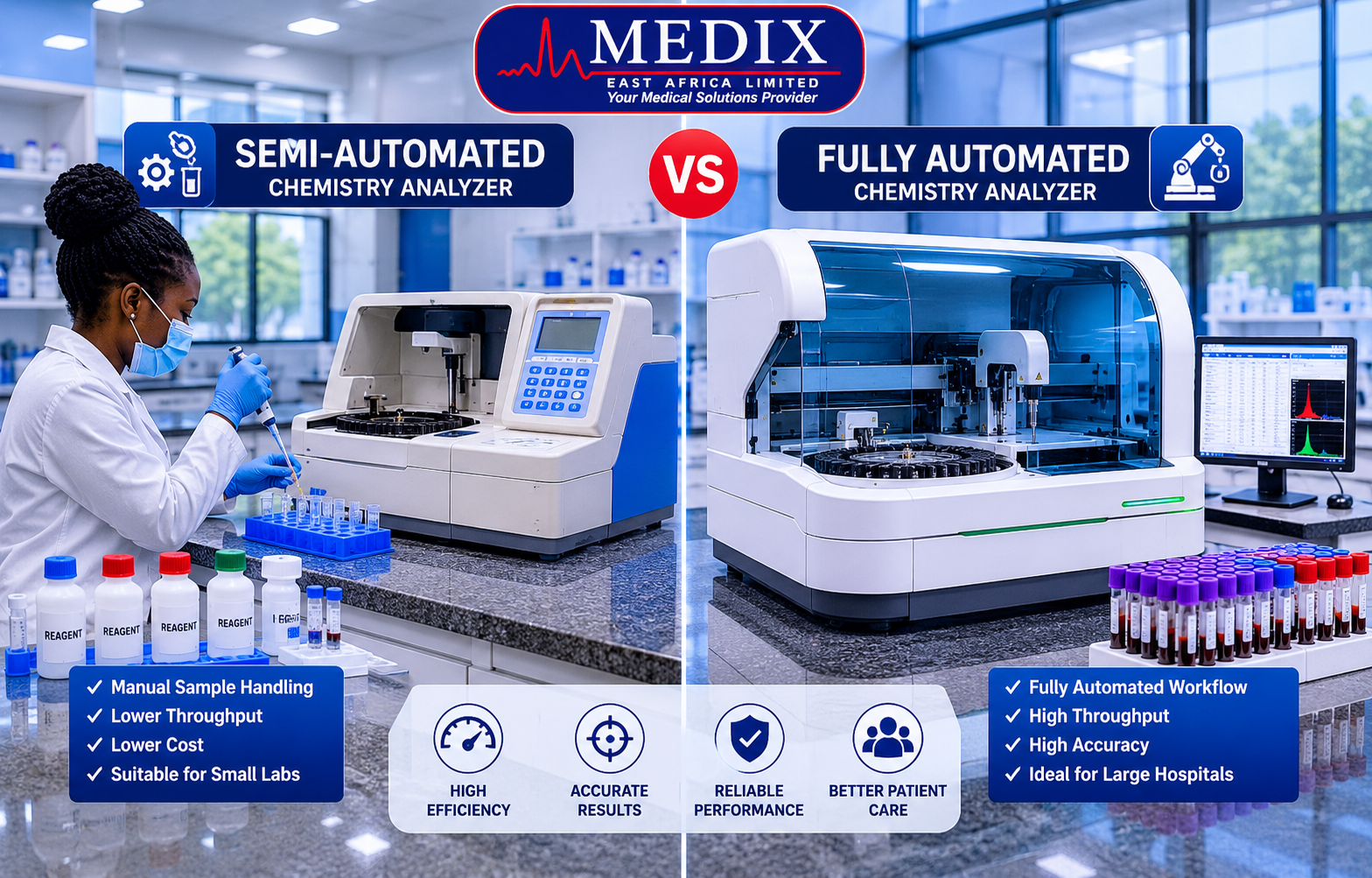
Both systems play an important role in modern diagnostics, but they differ significantly in workflow automation, throughput capacity, operational efficiency, maintenance requirements, and cost.
Choosing the right analyzer depends on several factors, including laboratory workload, budget, staffing, infrastructure, and long-term operational goals.
This guide explains the major differences between semi-automated and fully automated chemistry analyzers and helps healthcare facilities understand which solution best suits their laboratory environment.
Table of Contents
- What Is a Clinical Chemistry Analyzer?
- Importance of Clinical Chemistry Testing
- What Is a Semi-Automated Chemistry Analyzer?
- What Is a Fully Automated Chemistry Analyzer?
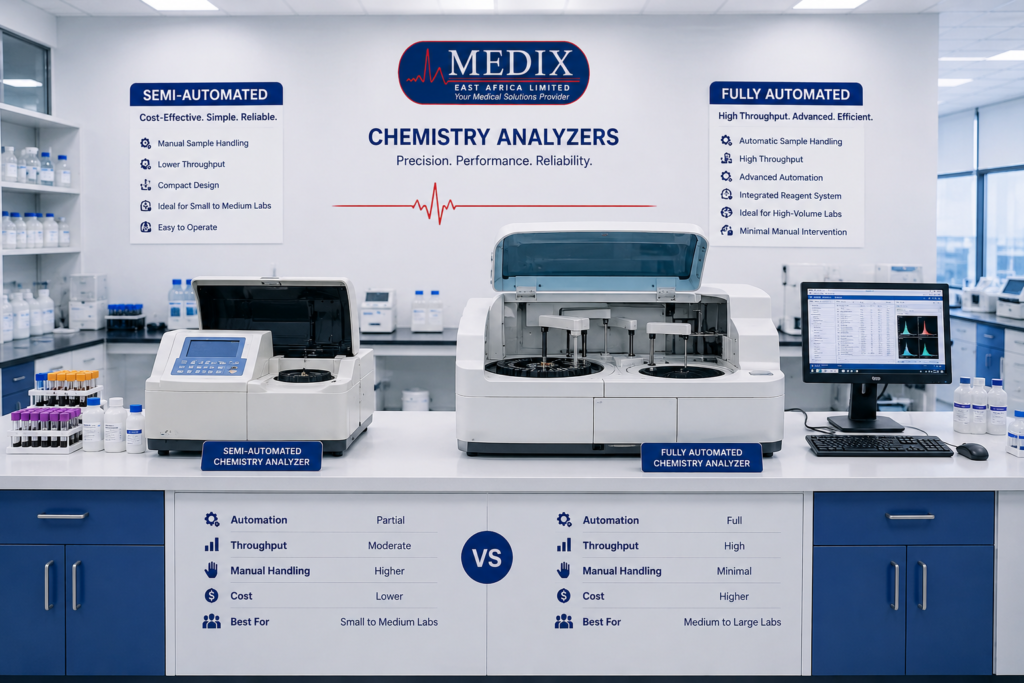
- Main Differences Between Semi and Fully Automated Systems
- Workflow Comparison
- Throughput and Efficiency
- Advantages of Semi-Automated Analyzers
- Advantages of Fully Automated Analyzers
- Cost Considerations
- Reagent Management Differences
- Maintenance Requirements
- Laboratory Applications
- Which Laboratories Need Semi-Automated Systems?
- Which Laboratories Need Fully Automated Systems?
- Future of Laboratory Automation
- Frequently Asked Questions
- Conclusion
What Is a Clinical Chemistry Analyzer?
A clinical chemistry analyzer is a laboratory diagnostic system used to measure chemical substances in blood, serum, plasma, urine, and other biological samples.
These analyzers help healthcare providers evaluate:
- liver function
- kidney function
- blood glucose levels
- lipid profiles
- electrolyte balance
- cardiac health
- metabolic disorders
Modern chemistry analyzers improve laboratory efficiency by automating biochemical testing procedures.
Importance of Clinical Chemistry Testing
Clinical chemistry testing is essential in routine medical diagnosis and patient monitoring.
These tests support:
- emergency care
- chronic disease management
- preventive healthcare
- treatment monitoring
- inpatient and outpatient services
Clinical chemistry analyzers help laboratories provide fast and reliable diagnostic results.
What Is a Semi-Automated Chemistry Analyzer?
A semi-automated chemistry analyzer performs some testing processes automatically while requiring manual operator involvement for certain tasks.
Laboratory personnel may need to:
- prepare reagents manually
- pipette samples
- mix reagents
- initiate testing cycles
Semi-automated analyzers are commonly used in:
- small laboratories
- clinics
- rural healthcare facilities
- low-to-moderate workload environments
These systems remain highly valuable for facilities with limited budgets and moderate testing demands.
What Is a Fully Automated Chemistry Analyzer?
A fully automated chemistry analyzer performs nearly all testing procedures automatically.
The analyzer can automatically:
- aspirate samples
- dispense reagents
- mix solutions
- incubate reactions
- analyze results
- generate reports
These systems are designed for:
- high-volume laboratories
- referral hospitals
- research institutions
- specialized diagnostic centers
Fully automated analyzers improve workflow efficiency and reduce manual intervention significantly.
Main Differences Between Semi and Fully Automated Systems
| Feature | Semi-Automated | Fully Automated |
|---|---|---|
| Automation Level | Partial | Full |
| Manual Handling | Higher | Minimal |
| Throughput | Moderate | High |
| Workflow Efficiency | Moderate | Advanced |
| Staff Dependency | Higher | Lower |
| Initial Cost | Lower | Higher |
| Maintenance Complexity | Lower | Higher |
| Suitable Facilities | Small laboratories | Large hospitals |
The main difference lies in the degree of automation and workload handling capability.
Workflow Comparison
Semi-Automated Workflow
Operators typically:
- Prepare reagents manually
- Pipette samples
- Load reaction mixtures
- Start analysis manually
- Record or review results
This process requires more operator involvement and technical handling.
Fully Automated Workflow
The analyzer automatically:
- Identifies samples
- Dispenses reagents
- Performs mixing and incubation
- Measures reactions
- Generates results digitally
Automation improves consistency and reduces manual workload.
Throughput and Efficiency
Throughput refers to the number of tests processed within a specific period.
Semi-Automated Systems
Suitable for:
- low-to-moderate daily sample volumes
- routine testing environments
Fully Automated Systems
Designed for:
- high patient volumes
- continuous laboratory operation
- advanced workflow management
High-volume hospitals benefit significantly from fully automated systems.
Advantages of Semi-Automated Analyzers
Semi-automated systems remain practical for many healthcare facilities.
Lower Initial Cost
More affordable for smaller laboratories.
Easier Maintenance
Fewer complex components reduce servicing complexity.
Simpler Operation
Basic training is often sufficient for routine use.
Lower Reagent Consumption
May reduce operational expenses in low-volume environments.
Compact Design
Suitable for laboratories with limited space.
Advantages of Fully Automated Analyzers
Fully automated analyzers provide advanced operational benefits.
High Throughput
Capable of processing large sample volumes efficiently.
Reduced Manual Errors
Automation improves consistency and reliability.
Faster Turnaround Time
Results are generated more quickly.
Improved Workflow Management
Supports continuous laboratory operation.
Better Data Integration
Many systems integrate with Laboratory Information Systems (LIS).
Advanced Quality Control
Modern analyzers provide automated QC monitoring and calibration support.
Cost Considerations
Budget planning is important when selecting laboratory equipment.
Semi-Automated Systems
Typically involve:
- lower acquisition cost
- lower maintenance complexity
- moderate operational expenses
Fully Automated Systems
Usually require:
- higher initial investment
- advanced servicing support
- larger reagent inventory
- increased infrastructure requirements
However, high-volume laboratories often recover operational costs through improved efficiency.
Reagent Management Differences
Chemistry analyzers depend heavily on reagent quality and management.
Semi-Automated Systems
May require:
- manual reagent preparation
- manual loading
- more operator monitoring
Fully Automated Systems
Often feature:
- refrigerated reagent compartments
- automatic reagent dispensing
- onboard reagent tracking
Proper reagent handling improves analyzer performance and result accuracy.
Maintenance Requirements
Both systems require preventive maintenance and technical servicing.
Semi-Automated Systems
Maintenance is generally simpler due to fewer automated components.
Fully Automated Systems
Require:
- advanced servicing
- software support
- calibration management
- biomedical engineering expertise
Routine preventive maintenance improves analyzer lifespan and operational reliability.
Laboratory Applications
Semi-Automated Systems Are Commonly Used In:
- clinics
- health centers
- smaller laboratories
- outreach programs
Fully Automated Systems Are Commonly Used In:
- referral hospitals
- private diagnostic chains
- research institutions
- high-volume laboratories
Laboratory size and workload significantly influence analyzer selection.
Which Laboratories Need Semi-Automated Systems?
Semi-automated systems are suitable for facilities that:
- handle moderate sample volumes
- operate with limited budgets
- have smaller laboratory teams
- perform routine chemistry testing
These analyzers remain highly effective in many developing healthcare environments.
Which Laboratories Need Fully Automated Systems?
Fully automated systems are ideal for:
- large hospitals
- busy diagnostic centers
- laboratories handling continuous workloads
- institutions requiring rapid turnaround time
Automation becomes increasingly valuable as sample volumes grow.
Future of Laboratory Automation
Laboratory technology continues advancing rapidly.
Emerging trends include:
- artificial intelligence integration
- cloud-based diagnostics
- remote analyzer monitoring
- predictive maintenance systems
- advanced workflow automation
Modern healthcare facilities are increasingly adopting fully automated diagnostic systems to improve efficiency and patient care quality.
Frequently Asked Questions
What is the main difference between semi-automated and fully automated chemistry analyzers?
Semi-automated analyzers require partial manual operation, while fully automated systems perform most testing procedures automatically.
Which analyzer is better for small laboratories?
Semi-automated analyzers are often more suitable for smaller laboratories with moderate testing workloads and limited budgets.
Why are fully automated analyzers more expensive?
They contain advanced automation systems, higher throughput capability, integrated software, and more complex components.
Do fully automated analyzers reduce human error?
Yes. Automation reduces manual handling and improves testing consistency.
Can both systems perform routine chemistry tests?
Yes. Both analyzer types can perform routine biochemical testing effectively when properly maintained.
Conclusion
Both semi-automated and fully automated chemistry analyzers remain essential in modern laboratory diagnostics. The best choice depends on laboratory workload, staffing, operational budget, testing complexity, and long-term healthcare goals.
Semi-automated analyzers provide affordable and reliable solutions for smaller laboratories, while fully automated systems offer advanced workflow automation, higher throughput, and improved operational efficiency for larger healthcare institutions.
Healthcare facilities should prioritize reliability, technical support, reagent availability, and preventive maintenance when selecting clinical chemistry systems.
As healthcare laboratories continue modernizing across Kenya and East Africa, laboratory automation will remain central to improving diagnostic accuracy, workflow efficiency, and patient care outcomes.